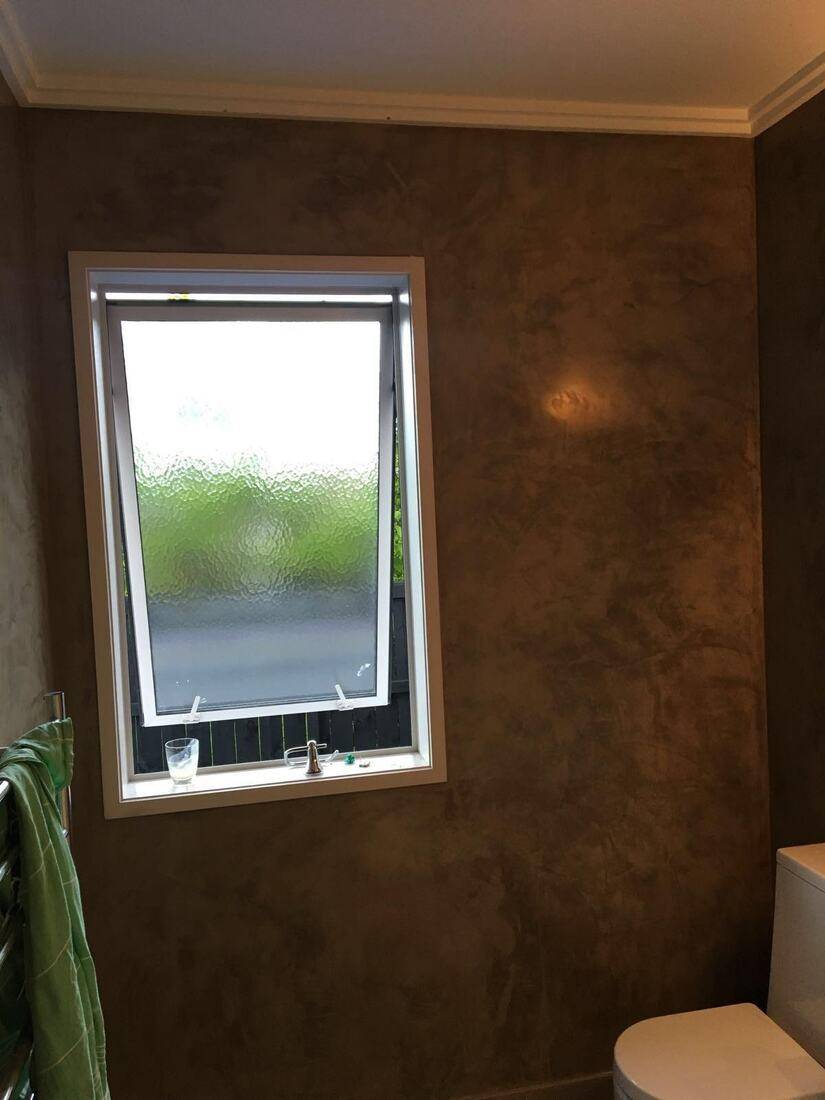
Short answer: yes, above splash height and on the ceiling. Lime is one of the better bathroom materials there is: it is vapour-open, naturally alkaline and inhospitable to mould. What it is not is a shower lining. The question is never really "can it go in a bathroom" but "where in the bathroom" and the answer is a line you can usually point to on the wall.
Why lime suits a bathroom
A bathroom is a room where the air is wet for an hour a day and dry the rest. Lime handles that well. It takes up moisture from steamy air and gives it back as the room dries, rather than letting it condense and run on a sealed surface. Because it is highly alkaline, mould struggles to establish on it and because it is part of the wall rather than a film on it, there is nothing to peel or bubble in the steam.
That is why a well-ventilated bathroom with Venetian plaster on the walls and ceiling can feel calmer and drier than the same room in gloss paint. The material is doing some of the work.
Where the line falls
We think of a bathroom in three zones and the zone decides the finish.
Wet zone. Inside the shower enclosure and the walls around a bath with a shower over it. Water runs down these walls daily. Venetian plaster does not belong here. Neither wax nor a breathable water-repellent will stop water that runs and the only seal that would is a polyurethane film. That would stop the lime breathing and make the wall a worse version of something else. Here we use tadelakt or microcement, both of which are built for water.
Splash zone. Behind the basin taps, around a freestanding bath, beside a WC. Water lands here, but in drops rather than streams and it is wiped. This is a judgement call made on the specific layout. Often the answer is a microcement or tadelakt splashback with Venetian plaster running above it. Sometimes, with a deep basin and a careful household, a sealed Venetian plaster is fine. We would rather look at the room than give a rule.
Dry zone. Everything above splash height, the walls away from the fittings and the ceiling. This is where Venetian plaster belongs and where it looks its best, because bathrooms tend to have good raking light from a window or wall lights.
How it is finished in a bathroom
The build-up is the same as in any other room: substrate corrected, mineral primer, base coats, finish coat pressed in wet, then compressed to the sheen you chose. What changes is the last step. A dry room gets a natural wax or soap. A bathroom wall gets a penetrating mineral water-repellent instead. It is invisible and brushed on after a few days and it does not form a film, so the lime keeps breathing while it sheds splashes and condensation.
Sheen matters too. A satin or burnished finish is compressed harder than a honed one, which closes the surface and makes it easier to wipe. A very matt finish is beautiful in a bathroom, but it shows water marks for longer while it dries.
The pairing we build most
The bathrooms we are proudest of rarely use one material. A typical specification:
- Walls and ceiling: Venetian plaster or Marmorino, water-repellent sealed.
- Shower enclosure: tadelakt or microcement, tanked behind as a sealed system.
- Floor: microcement, continuous into a level shower with no tiles or grout.
The three share a mineral, hand-made character, so the change from one to the next reads as a change of texture, not a change of material. We have written up microcement vs tadelakt and how a microcement bathroom is waterproofed if you want the detail of the wet side.
Ventilation is not optional
Lime manages humidity; it does not remove it. A bathroom with no working extractor, or one where the extractor is switched off because it is noisy, will have condensation sitting on every surface whatever they are made of. Before we plaster a bathroom we check there is extraction that runs long enough after a shower to clear the room. If there is not, we say so and suggest it is fixed first, because no finish should be asked to make up for it.
Looking after it
- Wipe splashes with a soft damp cloth. Most marks lift if you deal with them the same day.
- Use a pH-neutral cleaner. Lime is alkaline and acids etch it, so keep limescale removers, vinegar-based sprays and bleach away from the walls.
- Do not scrub. Abrasive pads and cream cleaners dull a burnished surface.
- Refresh the water-repellent every few years, or sooner on walls that get the most splashing. It is a quick visit, not a redecoration.
Our full care routine is in caring for polished plaster and microcement.
When we would say no
- A shower over a bath with no screen, where the whole wall gets wet.
- A bathroom with no extraction and no plan to add any.
- A family bathroom where you want to hose the walls down and never think about them. Porcelain or microcement will be happier there.
- Any wall with an active leak or damp behind it. That gets fixed first, always.
The short version
Venetian plaster works beautifully in a bathroom above the splash line and on the ceiling, sealed with a breathable water-repellent rather than wax. Where water runs, use tadelakt or microcement and let the plaster take over above it. Send us a photo of the room and a rough plan and we will mark where the line falls before you choose anything. It is the kind of question we answer every week across London and the South East.
Questions we get asked about Venetian plaster in bathrooms
Can Venetian plaster go in a shower?
No. Where water runs down the wall every day, we specify tadelakt or microcement, both of which are designed for wet zones. Venetian plaster goes above and around them.
Is Venetian plaster waterproof?
It is water-resistant once sealed with a mineral water-repellent, which is enough for splashes and steam. It is not waterproof in the way a tanked shower enclosure is and we never treat it as if it were.
Does Venetian plaster get mouldy in a bathroom?
Lime is highly alkaline, which makes it inhospitable to mould and it manages humidity rather than letting water condense on it. With working extraction, mould is rarely an issue.
Can you put Venetian plaster on a bathroom ceiling?
Yes. The ceiling is one of the best places for it in a bathroom, because steam rises and lime handles it well.