
Home - Rooms - Kitchens
Seamless microcement kitchens.
Worktops, splashbacks, cabinetry and floors in one continuous hand-trowelled surface - no grout lines, no joints, no place for anything to hide.
Why microcement in a kitchen
The kitchen is where seamless earns its keep.
A kitchen is the hardest-working room in a house and the one where grout fails first. Microcement removes the joints entirely: a worktop flows into an upstand, an upstand becomes the splashback, the island wraps in a single curve. Because the material is applied by hand over what is already there, it takes the shapes a factory can't - radiused ends, waterfall edges, integral drainer grooves - and it takes them in the colour you choose, matched on a physical sample in your own light.
It is also honest about what it is. Microcement is a mineral surface with a sealed finish; it reads as stone rather than plastic, it takes on a soft patina with use and it is repaired by hand rather than replaced. Clients who love it are the ones who wanted a kitchen that looks like a material, not a product.
Where it goes
- Worktops and islands. Formed over a rigid substrate, sealed to a food-safe, wipe-clean grade. Heat pads for pans, boards for knives - the same care you'd give stone.
- Splashbacks. The natural continuation of the worktop, with no joint at the junction to trap grease. Behind a hob we specify the higher-heat seal and detail the hob edge properly.
- Cabinetry and door fronts. Applied to prepared door blanks and panels for a monolithic run of units in the same finish as the walls - the look in the render above.
- Floors. Kitchen through to living space without a threshold. Warm underfoot, easy to clean, at its best over underfloor heating - more on floors here.
The three questions every kitchen client asks
Does it stain? A sealed worktop shrugs off the meal; it is standing acids overnight - lemon, wine, vinegar left to sit - that can mark the seal. Wipe rather than soak and it stays as it was laid. Does it scratch? The seal is the working layer and it is sacrificial by design; treat it as you would a good stone, re-seal every few years and a scratch through the seal is a local repair, not a new worktop. Is it hygienic? More so than tile: no grout, no joints, a continuous non-porous surface that cleans with warm water and a neutral cleaner. Our care guide has the five-minute routine.
See it your way
Colour every surface of this kitchen.
Walls, floor, worktops, cabinetry and the splashback - pick a finish and a colour for each and watch the 3D kitchen recolour in real time, by day or by evening light. Then save the look or send it straight to us for a quote.
Open the kitchen visualiser→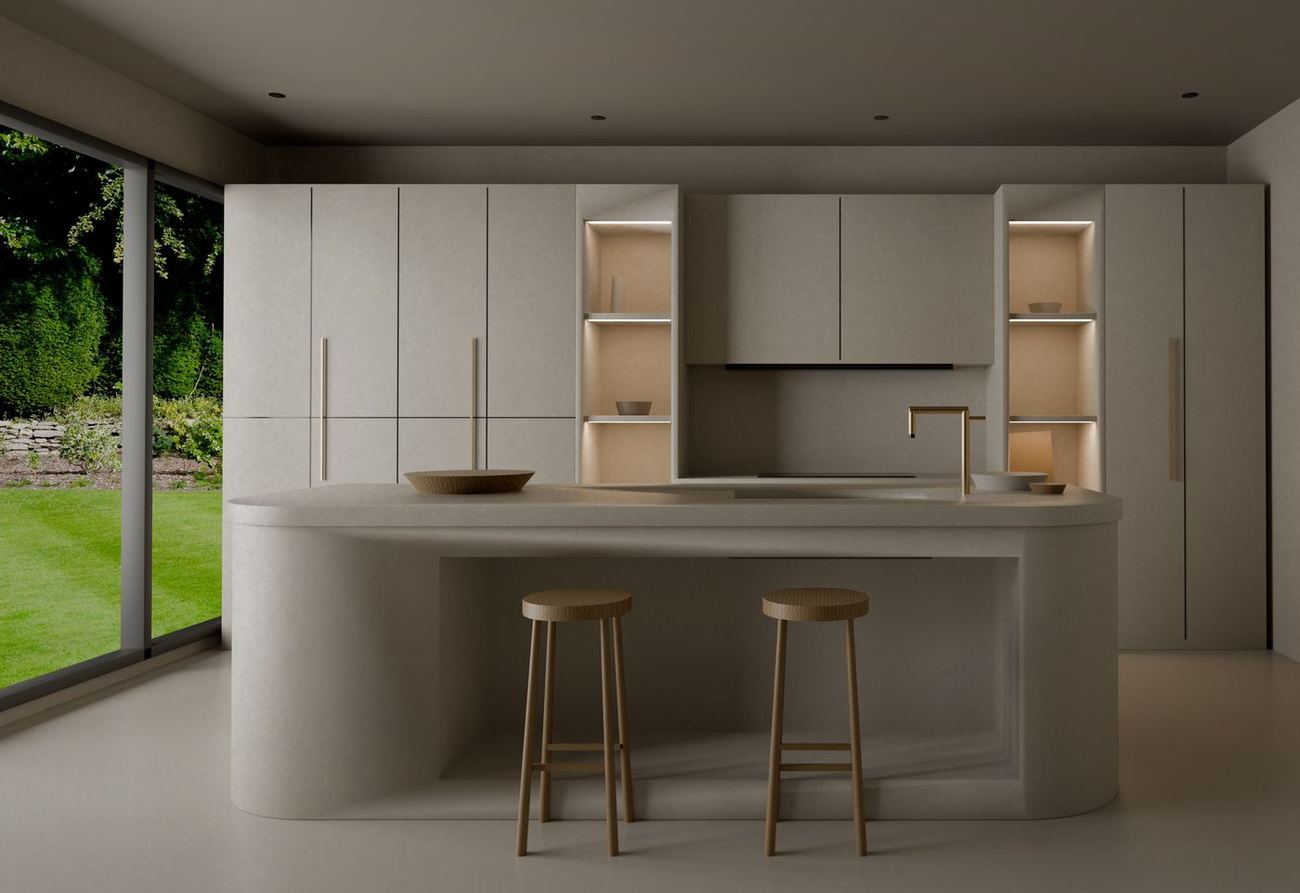
For architects & specifiers
Specifying a microcement kitchen.
Substrate requirements for worktops and door blanks, seal grades for hob and sink zones, thicknesses, tolerances and the maintenance schedule - all in the technical hub, with Clause-level wording for your specification on request - we are the installing contractor, so it reflects how the work is actually done.
Questions we get asked.
Can you put hot pans on a microcement worktop?
Warm pans yes, a pan straight off the hob no - use a trivet. That is the same advice given for laminate and for many engineered stones. If a household routinely puts hot cast iron directly onto the surface, a stone worktop is the more honest recommendation and we will say so.
Is a microcement worktop food safe?
The seal is what makes it so. We use a food-safe two-component polyurethane at a higher build than we would use on a wall, fully cured before the kitchen goes back into service. Cheaper single-component seals are the reason microcement worktops have a mixed reputation - the material itself is not the problem.
Can you apply it over an existing worktop?
Often, yes and it is one of the most cost-effective things microcement does. A tired laminate or a dated granite in sound condition can be resurfaced in place at 2-3 mm without taking the kitchen apart. Send us photographs and we will tell you whether yours is a candidate.
What happens if it gets damaged?
It is repaired in place. The area is abraded, re-coated and re-sealed and blended into the surrounding surface - no slab replacement, no dismantling the kitchen, no hunting for a matching batch. This is a genuine advantage over stone, which chips permanently.
Keep exploring
Bathrooms & wet rooms
The other room where grout gives up - sealed, seamless, spa-quiet.
Explore→Floors
Run the kitchen floor straight through the house, no thresholds.
Explore→More of our work
Kitchens, bathrooms, restaurants and feature walls across the South East.
Projects→Planning a kitchen?
Send us the plan and a photo - we'll tell you honestly what suits and what it costs.