
Systems & Finishes - V·03
Metallic & textured finishes.
Mineral surfaces carrying mica, bronze or oxide pigment, so the wall changes as you cross the room. Used sparingly and always on one plane rather than four.
These are the finishes that do something no paint can: they are directional. Suspended metallic and mica particles are laid down with the trowel, so they sit at an angle rather than flat and the surface reads differently depending on where you stand and where the light is coming from. Walk past a bronze-charged wall and it moves.
That behaviour is also the reason we are careful with them. A metallic finish is a feature, not a scheme. On one wall in a bar, a reception, a stairwell or behind a headboard it is genuinely striking. On all four walls of a living room it becomes exhausting within a week and we will say so before you spend the money.
The range
- Mica-charged lime. The subtlest. A Marmorino body with fine mica through it, so the movement is a shimmer rather than a shine. The version that works in a home.
- Bronze, brass and copper oxides. Warm metallics with real depth. Can be aged deliberately with a reactive patina for a verdigris or oxidised look.
- Iron oxide and reactive rust. A genuine oxidation process on the wall, then arrested and sealed. No two panels are the same and that is not something we can fully control - accept it or choose something else.
- Textured relief. Deliberately coarse, sculpted or combed surfaces where the interest is in the shadow rather than the shine.
Lighting is part of the specification
More than any other finish we install, this one lives or dies on the lighting design. A metallic wall lit flat from the front looks like a slightly odd paint colour. The same wall grazed from above or from the side is the reason people specify it in the first place. If lighting is still being designed, tell us - we would rather comment early than be asked to fix it with a finish afterwards.
Where it belongs
Feature walls, chimney breasts, bar fronts, reception desks, alcoves, stairwell returns, ceilings in small dark rooms. Commercially it is a strong choice for hospitality and retail because it photographs exceptionally well and holds up to traffic when sealed properly. Not suited to wet zones or floors.
Honest limits
Repairs are harder than on a matt finish. Because the effect is directional, a patch applied at a different angle will show, so a damaged panel is usually reworked wall-to-wall rather than spot-repaired. Price that risk into high-traffic locations, or choose a Marmorino where knocks are inevitable.
On site
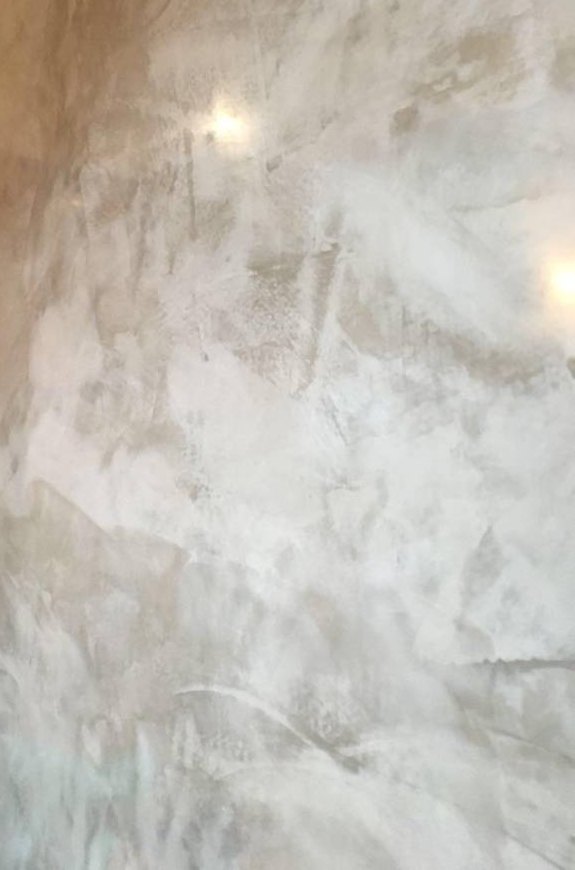
Metallic finishes, as installed.

Questions we get asked.
Will a metallic finish look dated in a few years?
A high-shine metallic across a whole room, probably. One wall in a mica-charged lime, no - that reads as depth rather than as an effect and it ages the way any mineral finish does. Our honest advice is to use the subtler end of the range on a single plane and let it be a detail rather than a statement.
Does it need special lighting?
It needs the right lighting, which is not the same as expensive lighting. The effect comes from metallic particles sitting at an angle, so light that grazes the wall from above or the side reveals it and light hitting it flat from the front kills it. If the lighting design is not finalised, tell us early - we would rather comment at that stage than be asked to compensate afterwards.
Can you match a specific metal or a patina?
Usually. We mix pigment in-studio and match against a physical reference - a piece of aged brass, a fabric, a photograph. Reactive iron oxide finishes are a genuine oxidation process on the wall, so there is inherent variation between panels that we can steer but not fully control. We show you that on a sample panel before you commit.
Is it durable enough for a bar or a reception?
Yes, sealed appropriately and it is a popular commercial choice because it photographs extremely well. The caveat is repair: because the effect is directional, a damaged area is usually reworked wall-to-wall rather than patched. In a very high-traffic location we would either detail a protective rail or steer you to a Marmorino.