

Home - Rooms - Bathrooms & Wet Rooms
Microcement bathrooms & wet rooms.
No tiles, no grout, no joints - walls, floor, vanity and bath in one sealed, seamless surface that reads like carved stone and cleans like glass.
Start with the question that matters
Is it actually waterproof? Yes - as a system.
The honest answer is that no coating on its own makes a bathroom waterproof and anyone who tells you otherwise is selling a coating. What makes a TVPC wet room watertight is the build-up beneath the finish: a waterproofing membrane over a corrected, primed substrate; reinforced base coats carrying the falls to the drain; the microcement finish; then a multi-layer seal. We pressure-test the waterproofing before a single decorative coat goes on. The result is a room with nowhere for water to go but the drain - no grout to fail, no silicone joints to blacken, no tile edge to lift.
That is the whole appeal. A tiled bathroom is a hundred small waterproofing decisions, each one a future maintenance job. A seamless one is a single, tested membrane under a single, continuous surface.
Where it goes
- Walls and shower enclosures. Floor to ceiling, around niches and benches, with no change of material at the wet zone.
- Floors and shower trays. Falls formed in the base coats rather than with cut tiles; wet-area floors are sealed to a textured, slip-resistant grade.
- Vanities and bath exteriors. The unit and the surround finished in the same material as the walls - the monolithic look in the visualiser below.
- Basins. Integral microcement basins formed as part of the vanity, sealed for daily use.
What it's like to live with
Warm water, a neutral cleaner, a soft cloth. That's the regime - there is no grout to scrub and no silicone to replace. Hard water leaves the same marks it leaves on glass and wipes off the same way. The seal is the working layer, re-done every few years in a short visit and any damage is repaired by hand and feathered into the surrounding surface rather than swapped out like a cracked tile. Full routine in our care guide.
Bath or walk-in shower?
Both work in the same finish and the visualiser shows a freestanding bath scheme so you can see how the finishes read in a whole room. If you're deciding between them, a walk-in wet room is where seamless microcement is most transformative - the whole room becomes the shower and there's nothing to step over or clean around.
See it your way
Colour every surface of this bathroom.
Walls, floor, vanity and bath exterior. Pick a finish and colour for each, see it by day or by evening light, then save the look or send it to us for a quote.
Open the bathroom visualiser→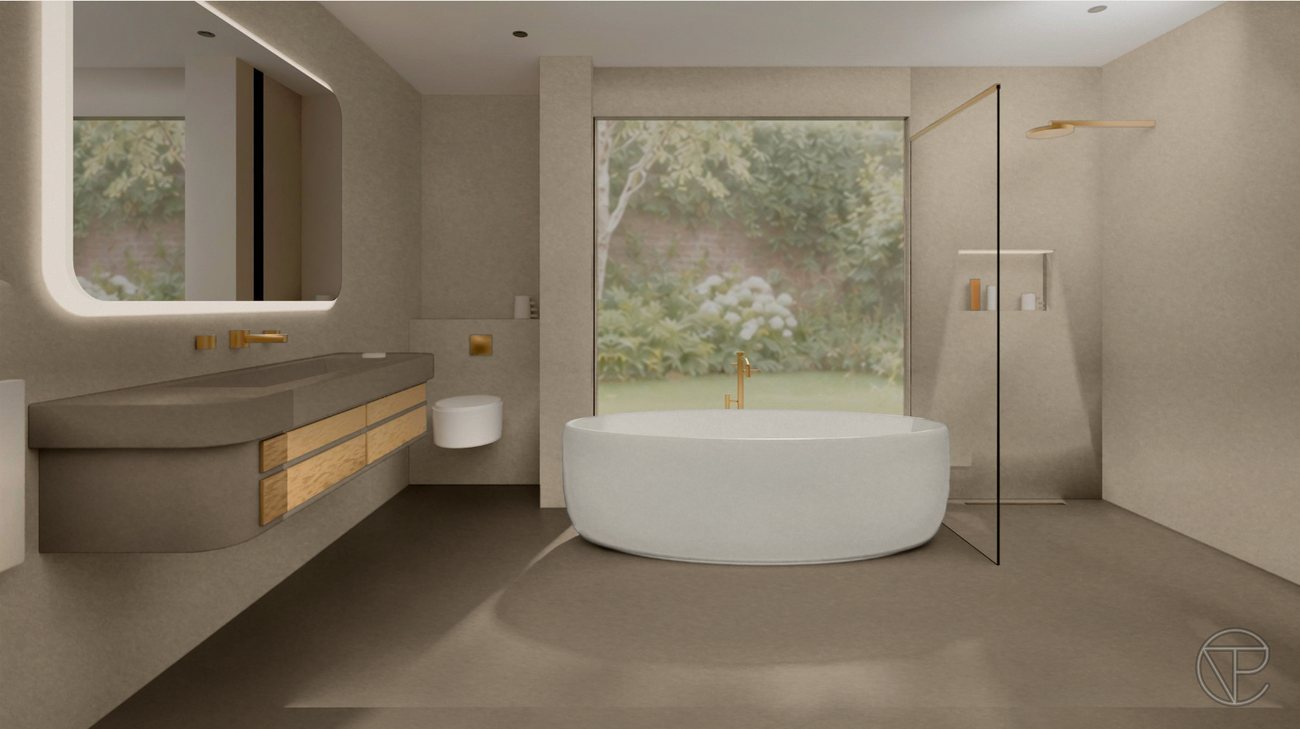
For architects & specifiers
Specifying a wet room.
Waterproofing membranes and testing, falls and drainage details, slip-resistance grades, substrate preparation and the maintenance schedule - in the technical hub, with Clause-level wording for your specification on request - we are the installing contractor, so it reflects how the work is actually done.
Questions we get asked.
Is a microcement bathroom really waterproof?
Yes, as a correctly built system. The waterproofing is a waterproofing membrane applied to the substrate with reinforcing tape at every internal corner, junction and pipe penetration and tested before any finish goes on. The sealed microcement above it has no joints or grout lines for water to find. The two work together; neither does the job alone.
Can microcement go over existing bathroom tiles?
Frequently and it is often the main reason people choose it - no strip-out, no skip, no dust. The conditions are that the tiles are sound and fully bonded, the existing waterproofing is assessed and the grout lines are filled and reinforced so they do not telegraph through. We check every tile by hand at survey and will tell you honestly if the substrate is not worth building on.
Is a microcement floor slippery when wet?
Not when specified properly. Shower zones and wet-room floors take an anti-slip additive in the final seal, which is invisible in the finish and gives a measurable pendulum value we can state in the specification. For a family bathroom or an accessible wet room we specify it as standard rather than offering it as an upgrade.
Will mould grow on it?
There is nothing for it to grow in. Mould in a tiled bathroom colonises grout, which is porous and holds moisture. A sealed microcement surface is continuous and non-porous, so routine cleaning keeps it clear. Ventilation still matters - no finish fixes a bathroom with no extract.
How long before we can use the bathroom?
Five to seven working days for the application itself, then a further cure period before the shower goes into full use while the seal reaches hardness. We give you exact dates in the programme and we will not shorten the cure to hit a date - a seal used early never performs as specified.
Keep exploring
Microcement or tadelakt?
Cool and exact, or warm and hand-polished - and why we often pair the two.
Read the comparison→Floors
Warm underfoot, seamless from the bathroom through the house.
Explore→Caring for it
The five-minute routine - and the three products to keep away.
Care guide→Planning a bathroom?
Send us the plan and a photo - we'll tell you what it needs, waterproofing included and what it costs.