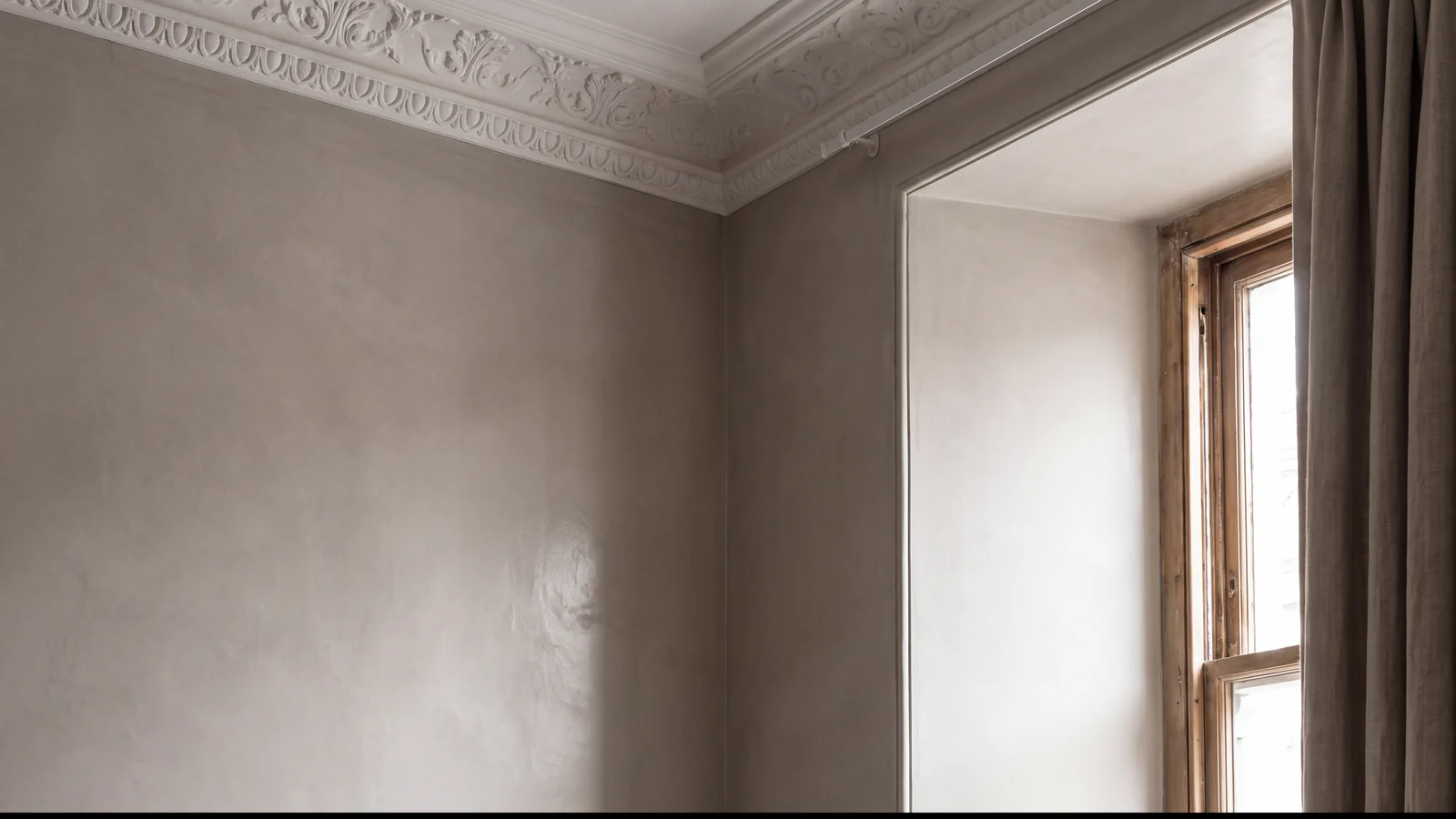
Venetian plaster is under two millimetres thick. It corrects nothing behind it and a compressed lime surface shows every undulation the light can find. So in London, where one street can hold a Georgian terrace, a Victorian conversion and a glass-fronted new-build, the finish is the easy part. What changes from house to house is everything underneath it.
This is how we approach the buildings we work in most.
Georgian and Regency townhouses
Solid brick walls, original lime plaster and some of the best proportions in the city: tall rooms, deep cornices, long stairwells lit from above. They suit Venetian plaster better than almost anything and they are the least forgiving buildings to get it wrong in.
- The walls must breathe. A solid wall needs a vapour-open route from the masonry to the room. That means lime-compatible preparation and a lime finish, never a sealing coat in between. More on that in lime plaster for period homes.
- Original plaster stays where it can. Sound historic plaster is repaired and kept. We do not strip a wall back to brick to make our lives easier.
- Height changes the job. A stairwell rising through three floors means towers, slower working and a second person for safety. It is not the same job as a hallway with the same wall area.
- Detail is hand work. Cutting in to a cornice, a deep sash-window reveal or a curved wall at the turn of a stair is done by hand and it is often where the finish looks its best.
If the house is listed, check with your conservation officer before historic plaster is altered. Lime is usually the material they want to see.
Victorian and Edwardian houses
The most common house we work in. Solid walls again, but usually with a century of repairs on them: gypsum patches, a re-skimmed room, lining paper over cracks, layers of emulsion. One room can hold three different substrates.
- We find out what is there at survey. Tapping walls, checking for hollow plaster and testing existing coatings, because lime is alkaline and will lift some paints.
- Chimney breasts are a favourite and a risk. They make superb feature walls, but old flues can carry soot and salts that stain through a pale finish. They are sealed and prepared on their own terms.
- Lath-and-plaster ceilings move. A ceiling that has been patched in gypsum often cracks along the patch lines. We assess whether it can take a finish or needs re-fixing first.
- Half-basements and ground floors. These are where damp shows first. It is diagnosed and dealt with before any decorative finish goes near it.
Mansion blocks
Mansion flats in Kensington, Marylebone, Maida Vale and Battersea are a different kind of job. The walls are usually solid with a later skim and in good condition. The building sets the rules.
- Working hours and noise rules set by the management company, often with quiet periods and no weekend working.
- Lift bookings for materials and equipment, sometimes by the half day.
- Nowhere to park or unload, so deliveries are planned to the hour.
- Protection of common parts, which can be a condition of the licence to work.
We ask for the building's requirements before we price, because they change the programme more than the wall area does. What does Venetian plaster actually cost? covers how access and logistics affect the figure.
Interwar and 1930s houses
Often the most straightforward. Cavity walls became common in this period and internal walls are usually gypsum on brick or block in reasonable condition. The usual checks apply, especially for old coatings and hairline cracks over door heads. Once the substrate is corrected and primed, these walls take Venetian plaster very well.
New-build and lateral apartments
Plasterboard, a fresh skim and often underfloor heating. Flat, modern and quick to prepare, with two risks that catch people out.
- Moisture. New plaster and new screeds hold a lot of water. Applying a lime finish over a skim that has not dried is asking for trouble, so we measure rather than take a programme date on trust.
- Movement. New buildings settle and board joints and the junctions between walls and ceilings are where it shows. We check how the boards are fixed and taped and detail the junctions so that any early movement does not run through the finish.
If a developer's programme puts us in before the building has dried out, we will say so and suggest a date that works, rather than apply over walls that are not ready.
Basements
London digs down and basement walls are usually tanked or lined with a drained membrane. A waterproofed wall cannot breathe whatever goes over it, so the finish has to suit the system behind it and the waterproofing guarantee must not be compromised by fixings or preparation. We coordinate with the basement contractor on what can go on their wall before we specify anything.
Getting the job done in London
The finish does not change between a Zone 1 flat and a house with a driveway, but the logistics do. Parking permits or suspended bays, congestion and emission charges, concierge hours and booked lifts all affect how a team works each day. So does a programme shared with other trades: these are wet, multi-coat finishes with cure time between coats and they run best when we have the room to ourselves for consecutive days. We plan all of this before we start and put it in writing, so none of it is discovered on day one.
See it in your own light
Every London job starts the same way. Visit our studio and sample library in Holborn by appointment to see the polish levels and colours in the hand. Then we make a physical sample panel in the room it is going into, so you choose in the light you will live with.
See our Venetian plaster in London page for the areas we cover, or read more about the Venetian plaster system itself.
Questions we get asked about Venetian plaster in London homes
Can Venetian plaster go on the walls of a Georgian or Victorian house?
Yes. It is lime, so it keeps solid walls breathable, provided the preparation underneath is breathable too.
Can you apply Venetian plaster in a new-build flat?
Yes, once the plasterboard and skim are dry and the board joints are taped and detailed with care. We measure moisture before we start.
Do you work in mansion blocks?
Regularly. We get the building's rules on hours, lifts and deliveries before we price, because they shape the programme.
Can Venetian plaster go on a basement wall?
It depends on the waterproofing behind it. We agree the finish with the basement contractor so it suits their system and does not affect their guarantee.